The concept of energy is a challenging one. We hear the word frequently, in very different contexts, but we can’t see it. When we say that a child is full of energy, is that the same stuff as the energy of a flashlight battery, or of a granola bar, or the energy that comes from the sun? Well, yes. Does it seem strange that we use the same word for all of that stuff? Yes. Although there are many forms of energy (including electrical energy, heat energy, light energy, motion energy, and chemical energy) and many different ways in which the presence of energy is measured (e.g., calories, kilowatt-hours, BTU’s, joules, etc.), ultimately, it’s all the same. Energy is energy. It can be transferred from one object to another; and it can be changed from one form to another (transformed).
This sequence of five investigations focuses on motion energy and provides some of the foundational ideas that prepare students for moving on to sequences that address thermal energy and electrical energy.
In this first investigation students share ideas about what the word energy means to them, watch a short video that includes 12 situations where energy is present in various forms, and then share ideas about what they notice that suggests the presence of energy. They can’t see energy directly, but they can observe evidence of the presence of various forms of energy (motion energy; thermal energy; light energy.) Although the video includes examples of several forms of energy, students quickly move on to explore motion energy by rolling a small rubber ball along a track. They are introduced to the concept that an object can have different amounts of motion energy, depending on its speed.
Learning Targets Introduced in this Investigation
- Energy cannot be seen or directly measured.
- All moving objects have motion energy.
- Speed is the indicator of how much motion energy an object has. If an object’s speed increases or decreases, its motion energy has increased or decreased.
| Sequence of experiences |
|---|
| 1. Introduce the new unit |
All Class |
5 Minutes |
| 2. Elicit students' ideas about energy |
Discussion |
20 Minutes |
| 3. Investigate the motion energy of balls |
Pairs |
20 Minutes |
| 4. Make meaning |
Discussion |
15 Minutes |
Materials and Preparation
For the class:
- Large sheets of paper and markers
- Energy video montage and a means for showing it to the class
- A rubber ball (1¼ in. diameter)
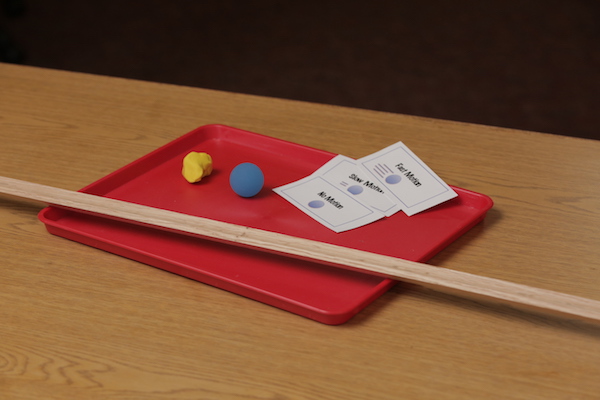
- A wooden track and modeling clay to level it (the teacher can use one of the student tracks) – See Preparation
Materials for each pair of students
For each small group of 2 students:
For each student:
Preparation:
- Read Motion Energy Curriculum Unit Overview.
- Read Scientific Models: An Introduction and What is an Energy Story? , on the Focus on Energy website in Motion Energy -> Resource Quick Links.
- Watch the Video Montage - Energy in Everyday Life and review the accompanying page of stills. The video is available on the Focus on Energy website on the Motion Energy Curriculum Unit page and under Resources -> For the Classroom.
- Watch the Motion 1: Setting Up and Using Equipment Video belowavailable on the Focus on Energy website on the Curriculum -> Motion Energy -> Resource Quick Links page.
Motion 1: Setting Up and Using Equipment Video
- A level track is very important to the investigation. Prior to the start of class, set up the track on the floor or on a table, in a place where it will be clearly visible to all. Place a ball on the track and use modeling clay to make the track level. When the track is level, the ball will not roll no matter where it is placed along the track.
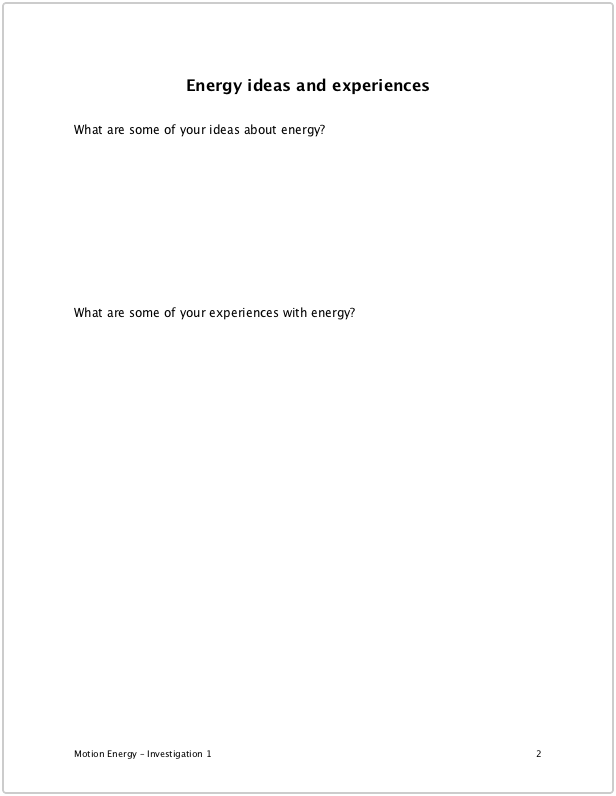
Notebook Pages
2. Elicit students’ initial ideas about energy
Discussion 20 Mins
Let’s begin. I’m sure you are familiar with the word energy, and know some things about energy.
Ask students to take 2-3 minutes to write about their ideas about energy and/or experiences they have had with energy.
Take about two minutes to have a few students share one of the ideas about energy that they wrote in their Student Notebooks. Listen without making judgments.
Note: The video shows various forms of energy (motion energy; thermal energy; light energy) as well as energy transfer (e.g. from the bowling ball to the pins). The video is intended to elicit students’ initial ideas about energy so you can build on them.
We’re about to see a short video. It takes about a minute. As you watch, keep thinking about energy and pay close attention to what’s going on.
 Play the Video Montage. It is available on the Curriculum -> Motion Energy -> Resource Quick Links page on the Focus on Energy website.
Video Montage - Energy in Everyday Life
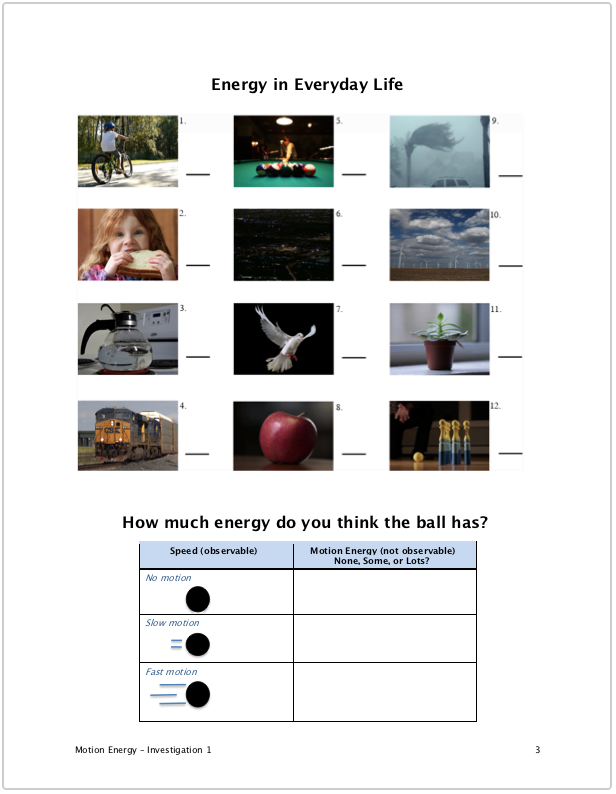
Ask students to turn to Notebook Page – Motion 1, page 3: Energy in Everyday Life, which includes 12 "stills" taken from the energy video montage.
Explain that each picture represents one of the video clips they just watched.
I’ll play the video again.
As you watch each clip, put the letter “E” (for energy) next to any picture from any video clip that you think contains evidence of energy.
Ask yourself, "What made me think that energy was present?"
Show the video a second time, while students mark their sheets. Then, ask students to use their sheets to anchor a short discussion.
The purpose of this discussion is to elicit student ideas about energy prior to instruction. It is not a time to teach.
Discussion Question:
To which clips did you assign an "E?"
What was the clue, or evidence, that caused you to think there was energy in this scenario?
Explain your thinking.
Does anyone want to add to that idea?
Is there anyone who did not think this clip should have an "E"? Would you explain why?
Note: Students may comment on several different energy forms. This is fine. If students comment on factors that are not actually visible (e.g., "There is fuel inside the train to make it go, so that is energy.") ask them if there are any clues or indicators of energy that they actually observed. The motion of the train is an example of an indicator that it has energy.
Some common examples of students' ideas prior to instruction are: living things have energy; things that move have energy; an apple that isn't moving and isn't attached to a tree does not have energy; lights on the train or the city are evidence of energy; the bicycle and the train are moving so they get energy from somewhere.
Introduce Motion Energy
You found evidence of energy in [almost] every clip. You described lots of different kinds of evidence – motion, light, sound. Here’s the challenge: we can’t see or feel energy so we have to look for clues or evidence that it is present.
Somebody mentioned that motion is a sign of energy. That’s a good connection to today’s investigation, which is to explore a kind or form of energy we call motion energy. If an object is moving, it has motion energy. For example, if a bike is moving, it has motion energy. We can talk about the motion energy of the bike.
Note: We purposely introduce the expression "the motion energy of the bike." In this curriculum, students will learn to track the flow of energy; they will focus on where the energy is, where it is going, and what are the indicators of its presence. They will say the energy of the ball, or the ball’s energy, and they will track where the ball’s energy goes. On the other hand, if you use the words "the ball uses energy," that expression may take the focus off where the ball’s energy is or even imply that the energy is used up or gone.
Introduce the investigation question
Our lessons always start with a question. Today’s investigation question is:
What Can Motion Tell Us About Energy?
3. Investigate the motion energy of balls
Pairs 20 Mins
A key idea for students to grasp is that energy can be present along a continuum of magnitudes: something can have the tiniest bit of energy, or a huge amount of energy, or any amount in between. It is not simply either present or not present. Having students roll a ball at different speeds, and later discuss how the ball can have different amounts of motion energy, helps build this idea.
Distribute Balls and Tracks
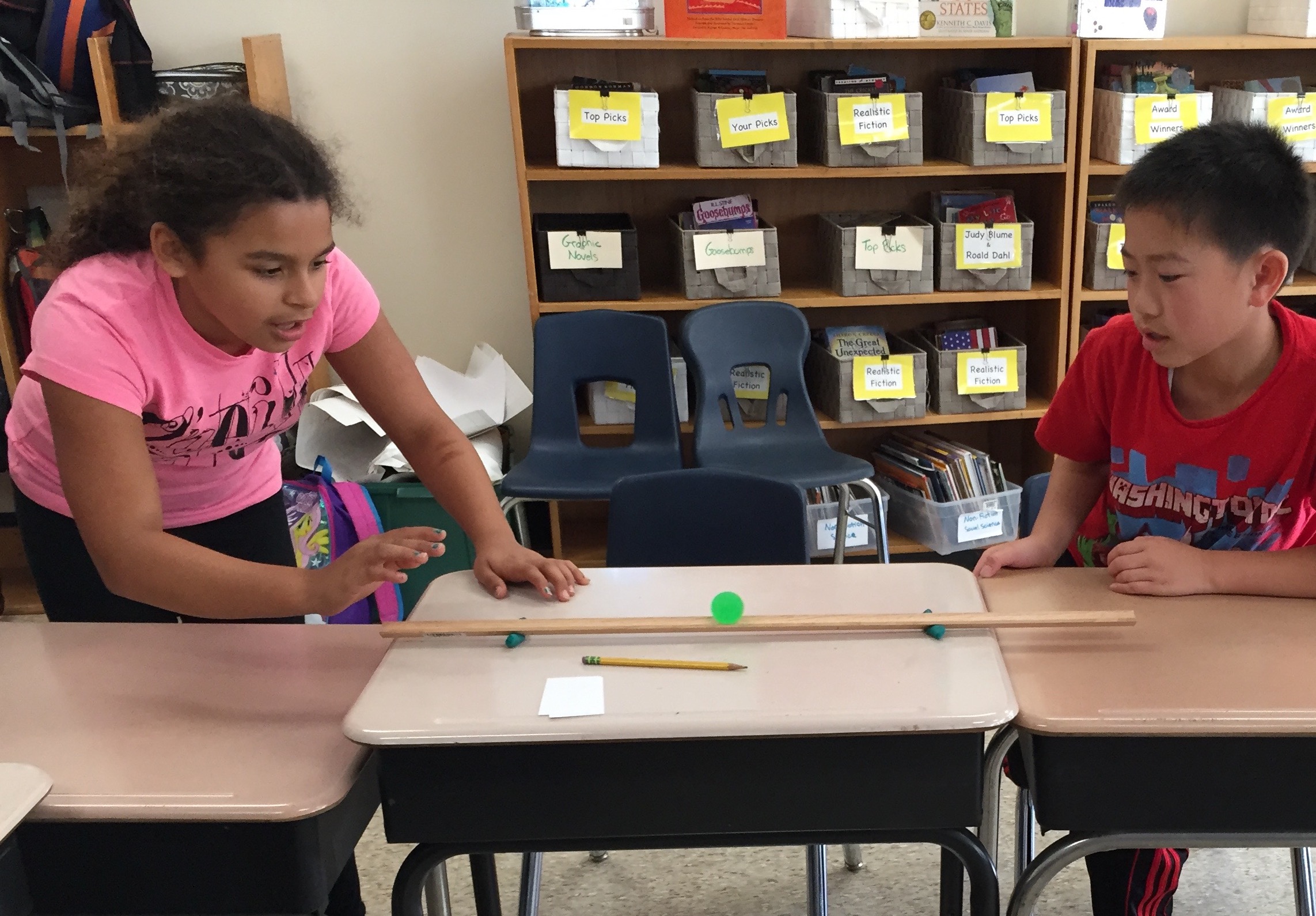
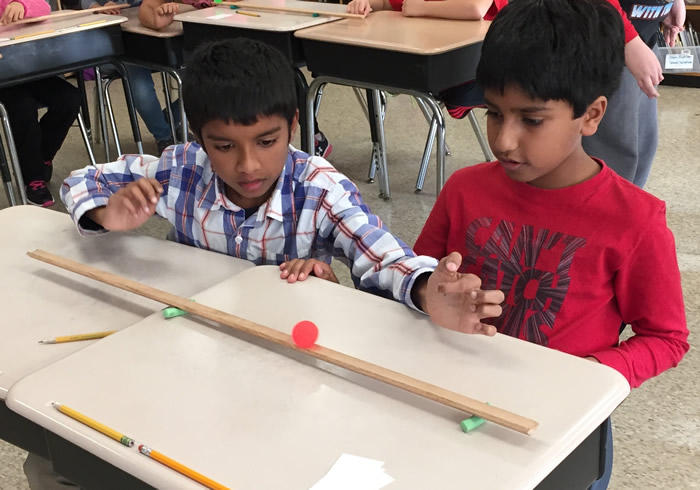
Give each pair of students a short piece of track, some modeling clay to level the track, and one ball, and ask them to explore rolling the ball along the level track, emphasizing that their pushes should be gentle enough to keep the ball on the track.
Note: Students will need help with the concept of "level". Some will think that "flat" is the same as level. Use a counter example to start. Put a ball on a sloping surface and explain that the ball moved because the surface was not level. Then demonstrate how to put a small amount of modeling clay under one end of the track and manipulate it to make it level. When the ball does not roll, the track is level.
Distribute Motion Notecards
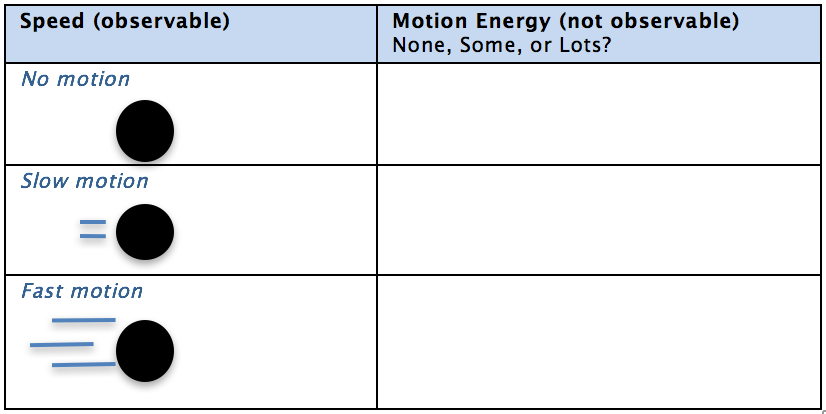
Give each pair a set of 3 motion notecards (see materials). Present the activity as a simple game. One member of each team holds the three cards, selects one to place face up on the table, and the other member responds by rolling the ball in a way that matches the description on the card: no motion (ball sits still); slow motion (gentle push); fast motion (bigger push). After each team member has a chance to play each role ask them to fill in the table on page 3 of their Notebook.
How much motion energy do you think the ball has as it rolls at different speeds? None, some, or lots?
Have students come together in a discussion circle around your demonstration track and ball.
You have all had a chance to roll the ball at different speeds: no motion, slow motion, and fast motion. What did you decide about the motion energy of the balls when they rolled at different speeds?
One of the cards you used said No Motion. Tell me the energy story of that ball.
How did you decide?
Does everyone agree?
- A ball that is not moving has no motion energy.
You’ve just told three energy stories. But you can’t see energy. How did you decide what the story is?
Note: For a given object, greater speed means more motion energy. Speed is an indicator of an object’s motion energy. However, an object’s speed is not the only factor in determining how much energy it has; an object’s mass is also a factor. For two objects moving at the same speed, the one with greater mass will have more motion energy. This unit will not introduce the complicating factor of mass to students at this point in time.
4. Make meaning
Discussion 15 Mins
The purpose of this discussion is for students to begin to generate a model of energy, based on their experiences.
Return to the investigation question:
What can motion tell us about energy?
Let students know that they will continue to explore motion energy in the next session. They will end today’s session by having a conversation about what they have learned about energy today, and particularly about motion energy.
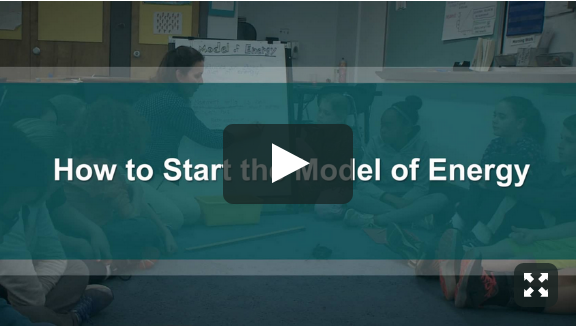
Start to Build a "Model of Energy"
We can’t see energy, but based on our experiences today (watching video clips, observing a ball on a track) what can motion tell us about energy?
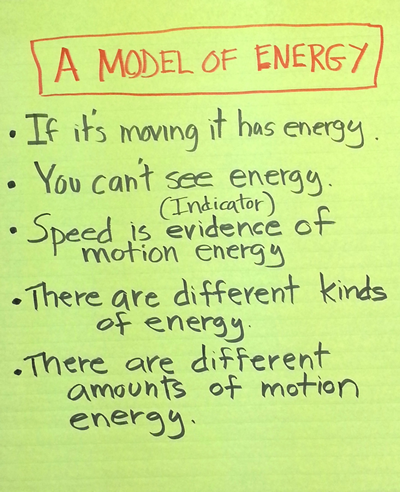
Example Model of Energy
Record statements on chart paper, white board, or something similar titled A Model of Energy. You will continue to add to or refine this list in future sessions.
As they generate this list, the class is starting to generate a model of energy-using evidence to describe the nature and behavior of energy. Using and generating models is an important scientific practice.
Possibilities include statements related to the video and/or to the balls. Listen for and record the key ideas of the Investigation, using student language.
- Energy cannot be directly seen or measured.
- All moving objects have motion energy.
- Speed is the indicator of how much motion energy an object has. If an object’s speed increases or decreases, its motion energy has increased or decreased.
 Motion Investigation 1 pdf