Sequence of Motion Energy Unit Activities

pdf file iconMotion Sequence of Activities pdf

1. What can motion tell us about energy?
Activity Learning Targets Introduced Representations Image of Activity
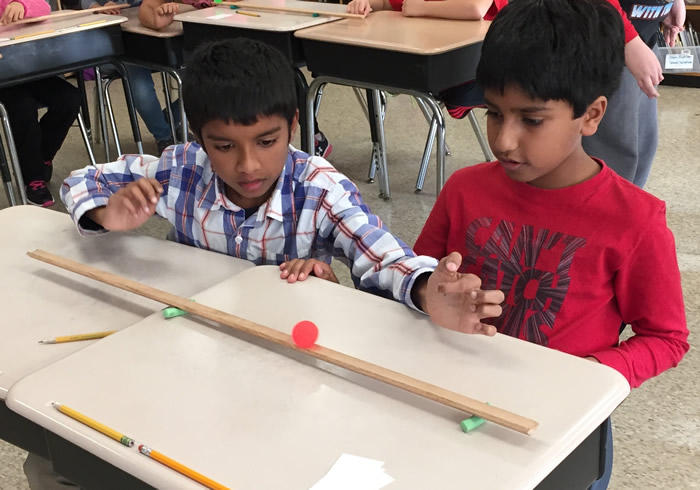
Rolling ball
  • Energy cannot be directly seen or measured.
  • All moving objects have motion energy.
  • Speed is the indicator of how much motion energy an object has. If an object’s speed increases or decreases, its motion energy has increased or decreased.
Cards with symbols (no motion, some motion, lots of motion)
2. Can a ball cause another ball to move AND not lose any of its own energy?

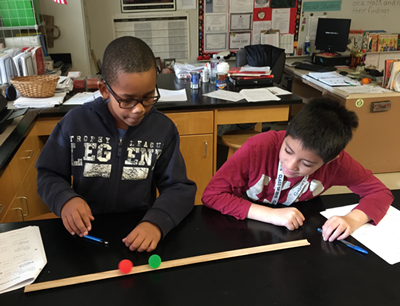
Colliding balls

Quick Check

  • Energy can move from one object to another object; this is called energy transfer.
  • Motion energy can be transferred between objects through pushes, pulls, hits, or collisions. Stronger interactions (e.g., bigger hits) transfer more motion energy.
  • Energy changes take place in multiples; whenever there is a loss of energy somewhere, there must be a gain in energy somewhere else (and vice versa).
  • A drawing or representation (such as energy bars) can show changes in the amount of energy an object has.
Energy bars
3a. Can a paint paddle gain and lose energy?
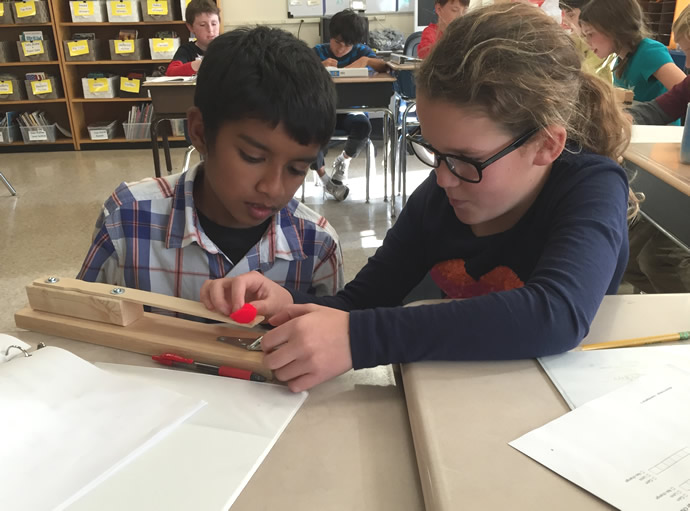
Paint paddle pom-pom launcher
  • An elastic object is any object that returns to its original shape after being deformed (bent, twisted, stretched, squeezed, etc.)
  • Deformation of an elastic object is the indicator of the object’s elastic energy. If an elastic object’s deformation increases or decreases, its elastic energy has increased or decreased.
  • When energy changes from one form to another, this is called energy transformation.
  • Motion energy can be transformed into elastic energy (and vice versa).
Energy bars
3b. What’s the energy story of the paint paddle and pompom?
Paint paddle pom-pom launcher
  • Energy cubes can be used to reason about energy flows and forms.
Sketches,
Energy cubes
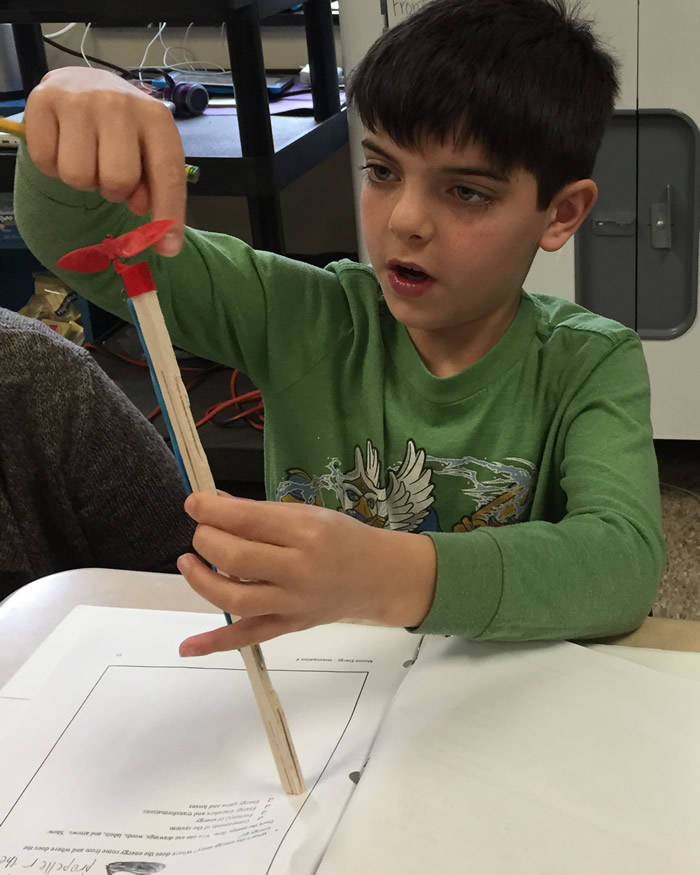
4. What’s the energy story of the propeller?

Rubber band and propeller

Wrap Up Probe

  • The Energy Tracking Lens questions, “Where does the energy come from?” and, “Where does the energy go?” provide a useful way of thinking about energy flow in any scenario.
  • Drawings and representations help reason about energy flow and transformation in a scenario.
Student sketches, Energy cubes