 pdf of Using Sketches to Document Energy Cube Movement
pdf of Using Sketches to Document Energy Cube Movement
Energy flow through a system is a dynamic process, changing from moment to moment across time and space. Likewise, sliding and flipping the energy cubes through a set of component circles is a dynamic process and a very effective way to represent energy flow through a system. The cubes and circles help students to reason about energy flow and allow them to share their thinking with others involved in the work.
However, the cubes themselves provide no lasting record of student work. This means that students do not have the opportunity to return to a proposal to reconsider it, and teachers have no record of student work to review. A sketch or a photo of the cubes and circles can depict a moment in time but neither is an effective way to capture a dynamic process. The Focus on Energy curriculum therefore suggests that students create a series of sketches that document the location of energy cubes at two or more key points in time, possibly before and after an event, or before, during, and after an event. Below are just three of the many possible approaches to such sketches.
While these sketches are helpful to both the students who developed them and their teachers, they are not meant to inform those who were not involved in the work. They typically do not provide adequate information to be useful for that purpose.
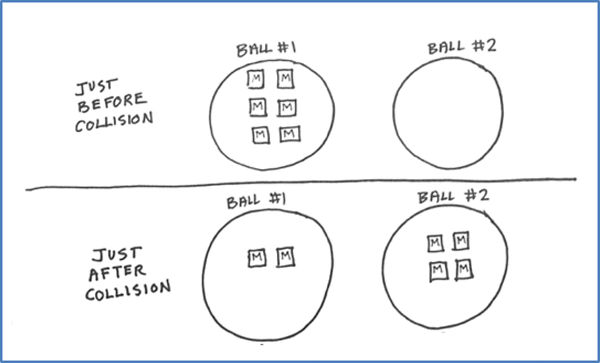
Example #1: This sketch shows the motion energy of two balls immediately before and immediately after Ball #1 collides with stationary Ball #2.
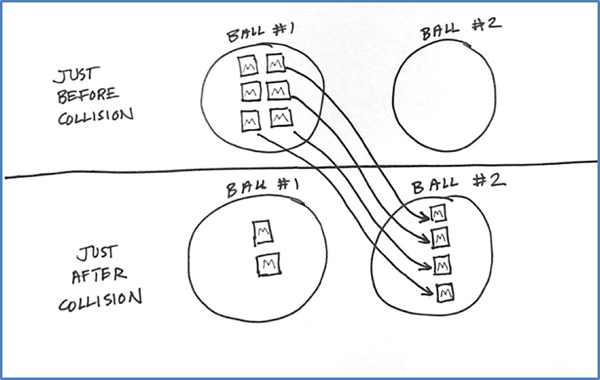
Example #2: This sketch shows the same event of balls colliding as well as the same result in Example #1, but uses arrows to highlights the fact that most of the motion energy of Ball #1 was transferred to Ball #2 during the collision.
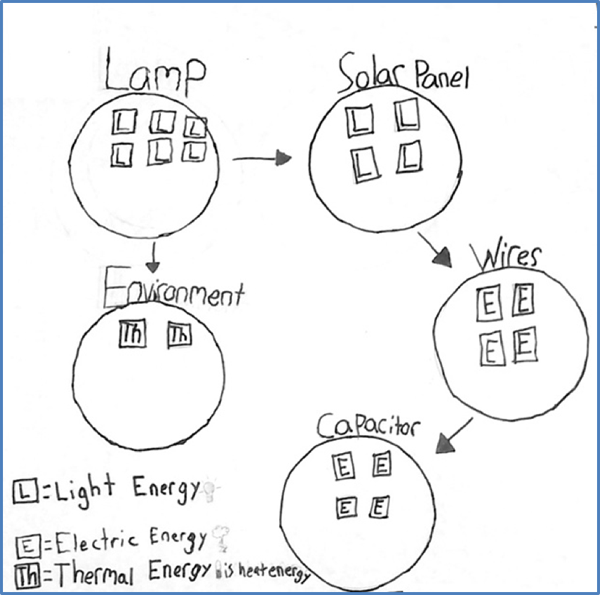
Example #3: This sketch uses a different type of representation. Arrows (vs a horizontal line) represent the passage of time as a “batch” of energy, represented by the cubes, moves through the system. Energy starts in the lamp, moves simultaneously to the solar panel and other parts of the environment, then through wires and into the capacitor.